
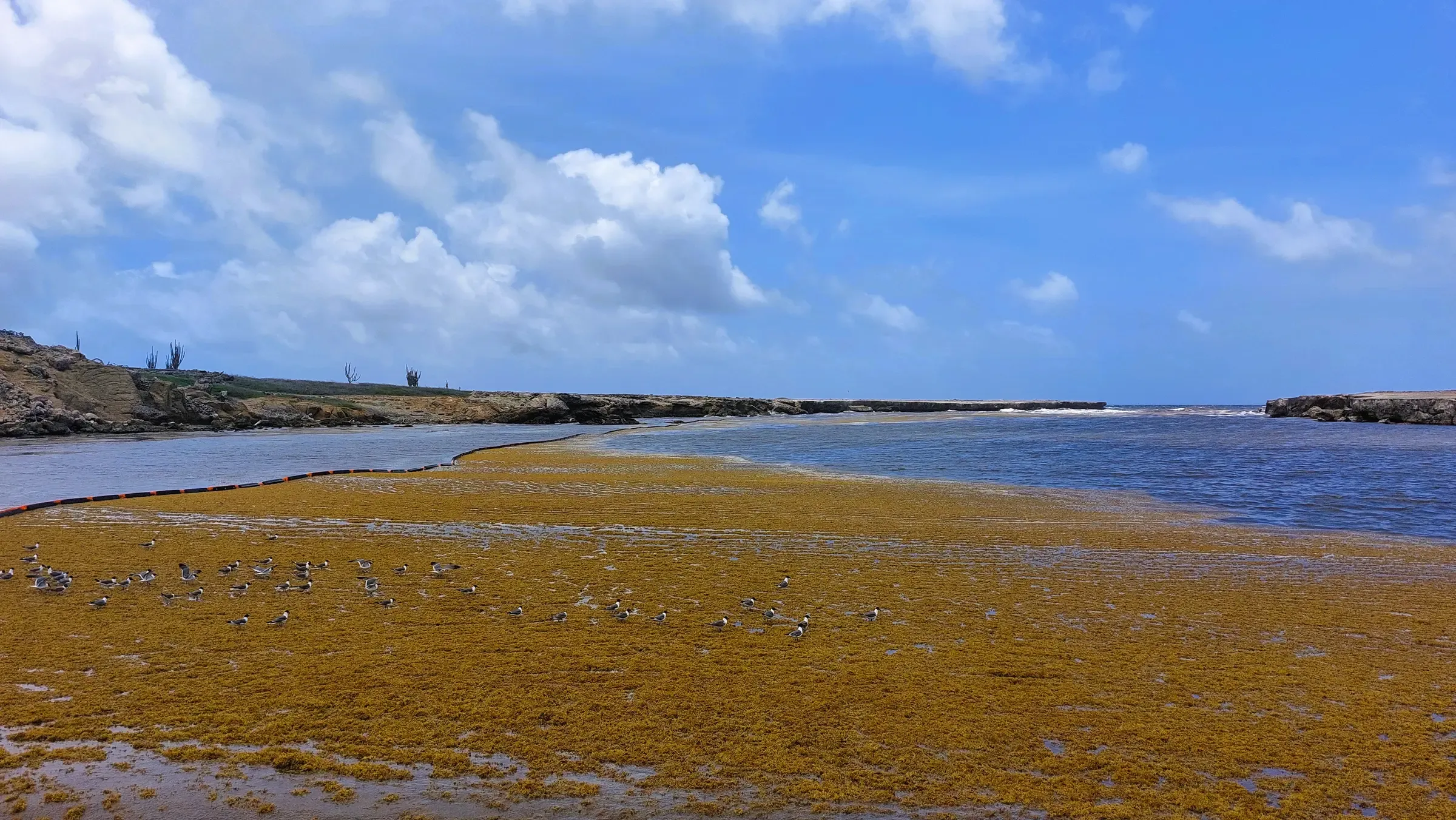
BonCirc
Bonaire faces significant challenges in managing organic waste streams, including increasing Sargassum influxes. Current practice, landfilling of organic waste, leads to methane emissions; leaching of heavy metals, nutrients, and micropollutants; and other environmental and health risks. The project BonCirc evaluated circular technical solutions to improve organic waste treatment. Different processing routes were analysed on techno-economic feasibility and circularity using the BREVIA tool (fka CAT).
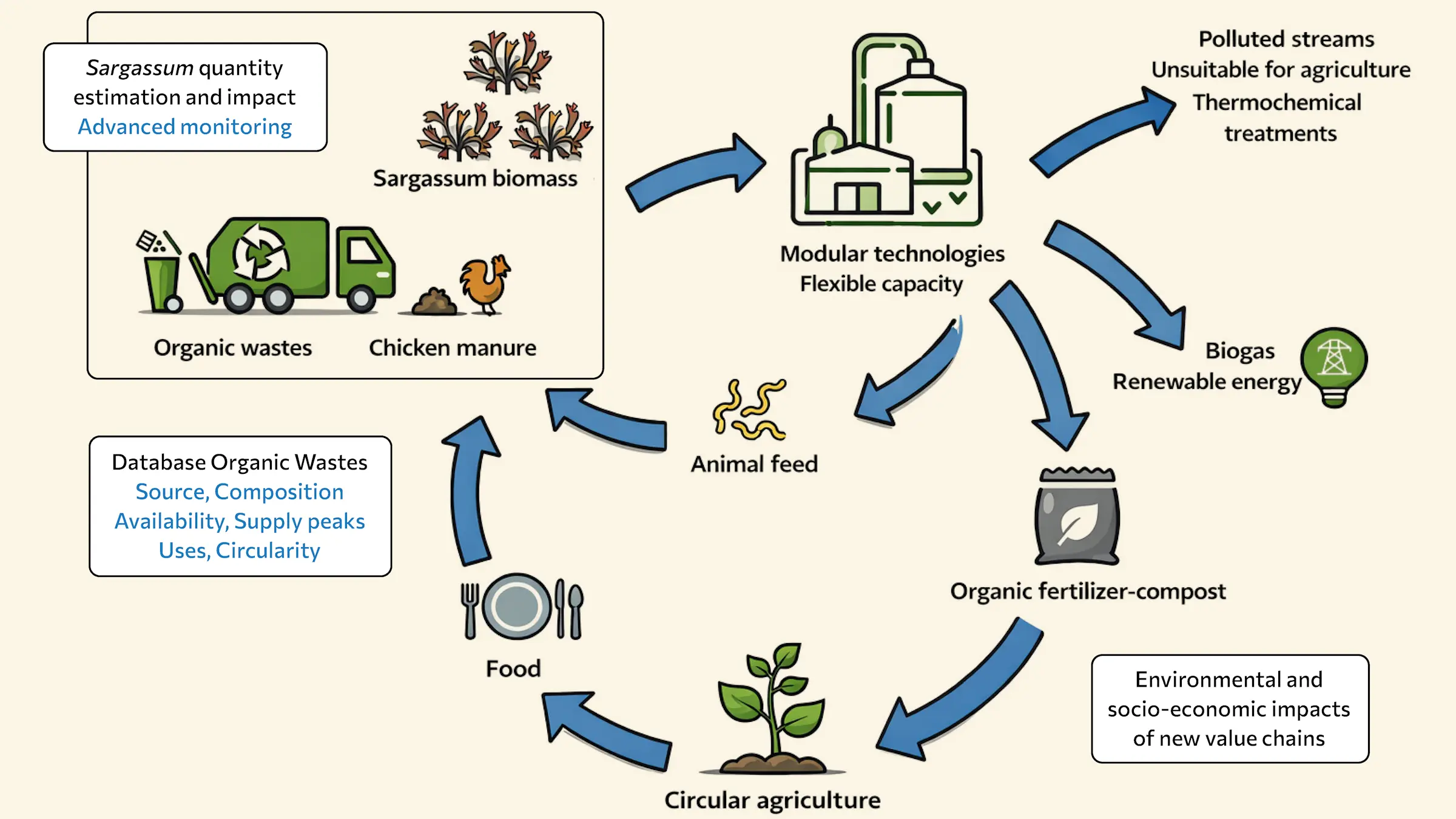
In Bonaire, the main collectable organic waste streams are chicken manure, the organic fraction of household and industrial waste, pruning waste, sewage sludge and Sargassum. Sewage sludge and sargassum contain micropollutants and/or heavy metals and should therefore be treated carefully to prevent these contaminants from entering the compost above safety limits.
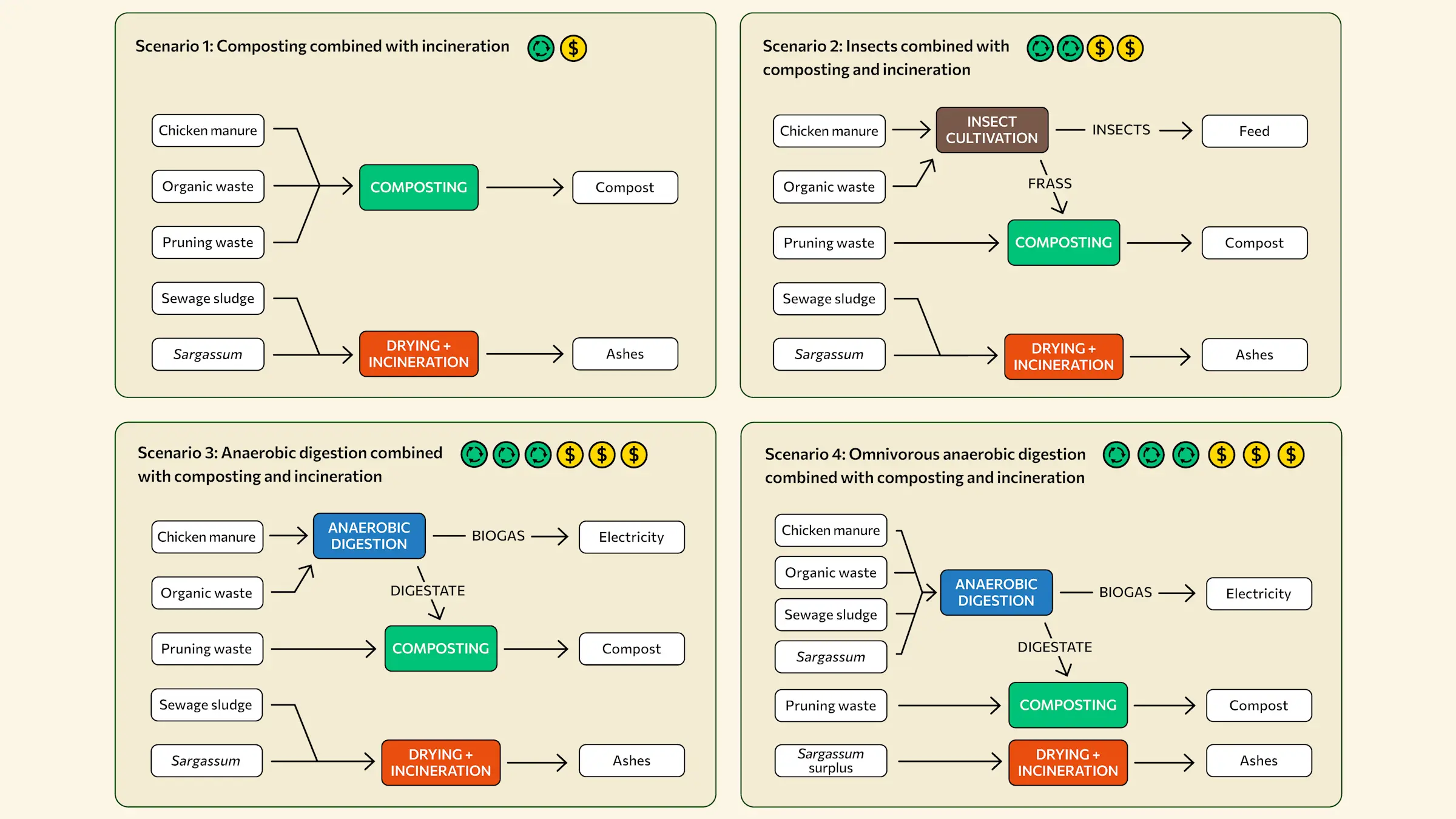
Four processing routes were analysed for organic waste treatment:
- Composting & incineration, in which the sewage sludge and Sargassum are incinerated. All the other organic waste streams are composted directly.
- Insects, composting & incineration, in which the sewage sludge and Sargassum are incinerated. The chicken manure is fed to black soldier fly larvae. The larvae can be used as feed. Furthermore, frass (faeces of larvae) is produced, which will be composted together with the organic fraction of household and industrial waste and pruning waste. -
- Anaerobic digestion, composting & incineration, in which the sewage sludge and Sargassum are incinerated. The chicken manure and organic fraction of household and industrial waste are anaerobically digested. The digestate is composted together with the pruning waste.
- Omnivorous anaerobic digestion, composting & incineration, in which the sewage sludge, a maximum of 20% of the estimated available Sargassum (based on its arsenic content), chicken manure, and organic fraction of household and industrial waste are anaerobically digested to produce biogas and digestate. The digestate would be subsequently composted together with the pruning waste. Besides, an incinerator is needed to treat the surplus (a minimum of 80%) of the Sargassum.
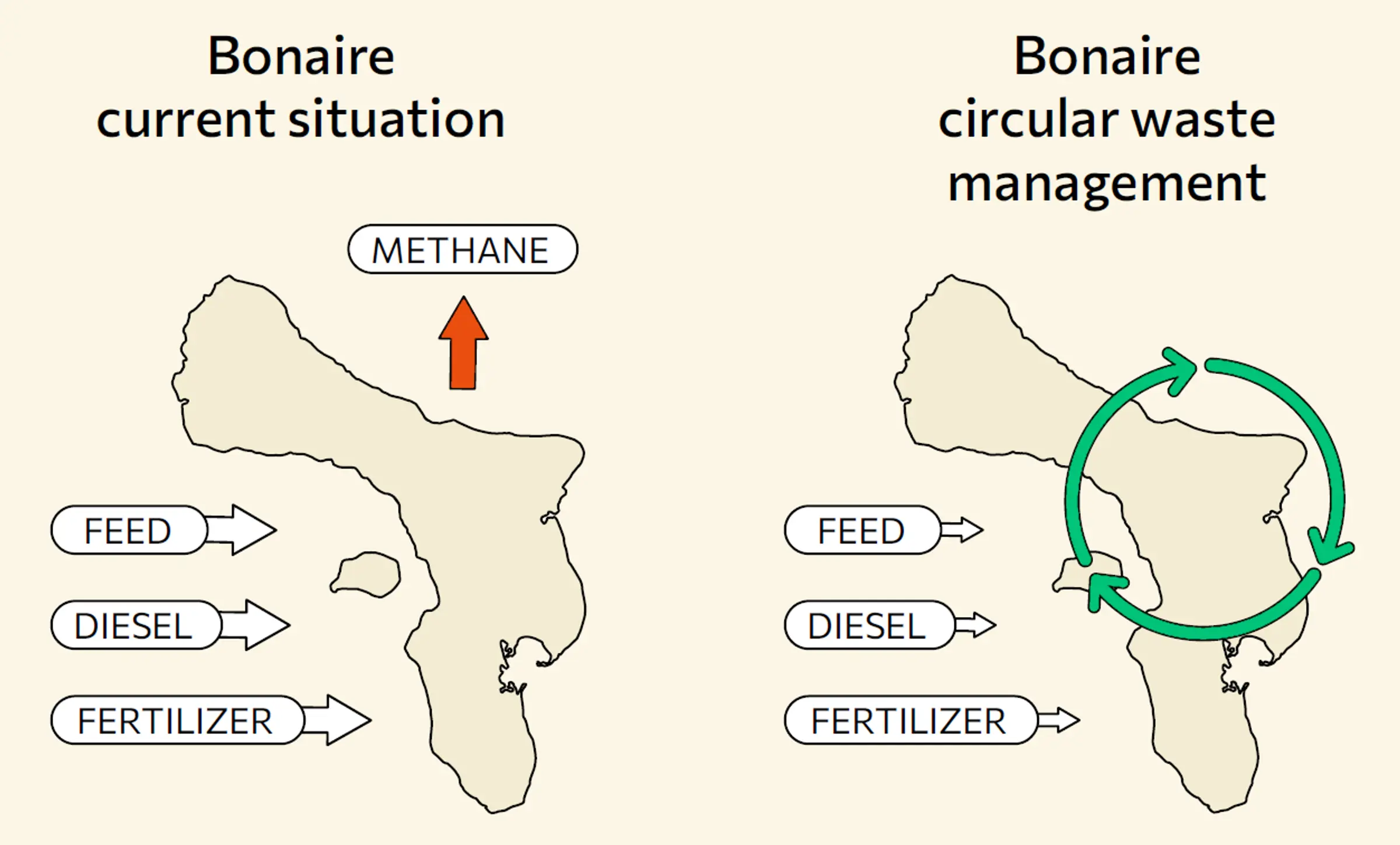
These routes can produce valuable products, such as compost, (pet) feed, and electricity. Converting waste into these products reduces reduce import of feed, diesel and fertilizers in Bonaire, contributing to a more resilient and circular Bonaire. The study showed that circularity increases from scenario 1 to scenario 4, but also showed an increase in costs, reflecting the addition of more technologies for waste valorisation to produce more products. Overall, there was a trade-off between costs and circularity: scenarios with higher circularity scores (scenario 3 and 4) show higher investment and treatment costs.
Main conclusions
- Landfilling organic waste leads to methane emissions and contamination of the environment and should therefore avoided.
- Increasing mass Sargassum influxes are damaging coastal ecosystems, affecting tourism, and creating public health risks. Action should be taken to reduce the Sargassum influx.
- Three treatment scenarios perform similarly overall and all outperform the current landfilling practice.
- Composting is required in every scenario and produces the main output; in any case, investment in composting infrastructure is advised.
- Local policymakers should choose the scenario that best matches the island’s environmental goals, circularity ambitions, and financial capacity.
LINKS
Project site on research.wur.nl
Policy brief Sustainable and Circular Organic Waste and Sargassum Management on Bonaire, 2026
WUR report System design options for circular uses of organic waste streams in Bonaire, 2025